
탐험가의 서클
SPEE3D 블로그에 오신 것을 환영합니다.
ASPI report on Australian industrial sovereignty by SPEE3D co-founder
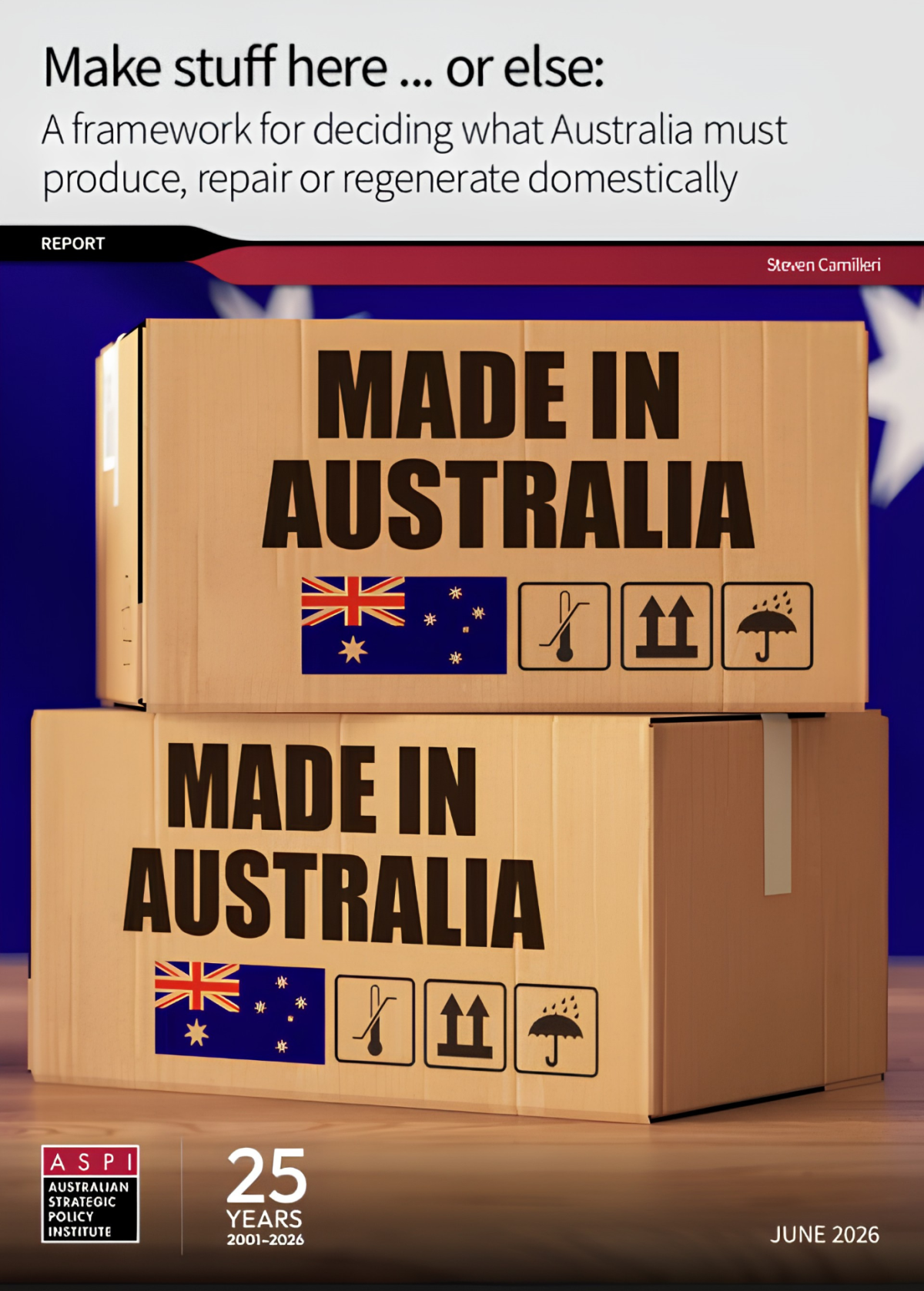
Make stuff here … or else introduces the ‘Sovereignty Countdown’, a practical test for deciding what Australia must be able to produce at home.
SPEE3D co-founder and chief technology officer Steven Camilleri has authored a new report, published by the Australian Strategic Policy Institute (ASPI), setting out a framework for deciding which goods and capabilities Australia must be able to produce, repair or regenerate domestically.
The report, Make stuff here … or else: A framework for deciding what Australia must produce, repair or regenerate domestically, argues that national resilience isn’t an abstract policy ambition; it’s a measurable engineering problem.
The Sovereignty Countdown
At the centre of the report’s framework is the Sovereignty Countdown: the length of time a critical system can keep operating if external supply is cut, drawing only on the reserves, substitutes and domestic capability already on hand. Every essential function, water, fuel, food logistics, power and communications, has a countdown like this running, yet most operators have never measured it. The report illustrates the idea with dependencies that are already publicly visible:
- Urban drinking water chemicals are often held in only a few weeks of supply, sometimes as little as a fortnight.
- National diesel cover is typically discussed in weeks rather than strategic dept.
- A disruption to imported fertiliser at planting time may not be felt until a harvest fails months later.
Not a case for self-sufficiency
The report doesn’t call for self-sufficiency or blanket protectionism. Instead, it makes the case for rebuilding a narrow, disciplined set of capabilities, specifically, those where the time to restore supply under pressure exceeds the buffers the country currently holds, while keeping trusted international partnerships central by using the distributed, digital and advanced manufacturing methods suited to a large continent with a limited industrial workforce.
The report, which builds on Camilleri’s 2025 Make Stuff Here blueprint, also recommends a national resilience test for critical-infrastructure operators, a minimum national survival threshold for essential systems, and financing mechanisms, including a continuity investment window and a role for superannuation capital, designed to make resilience investable rather than reliant on permanent subsidy.
Want to read the full report? Make stuff here … or else is available here on the ASPI website.