
Materials
Choose from a wide range of high-quality powders that deliver superior performance and durability.
410 Stainless Steel
Material characteristics
Acceptable machineability, moderate corrosion resistance, good ductility, medium strength
Applications
Couplings and adaptors, shaft flanges, stub axles, bushings, actuator arms, low-speed cam followers, medium duty gears, conveyors, rails, fixtures, brackets, housings, especially where 316L stainless falls short on strength or wear resistance.

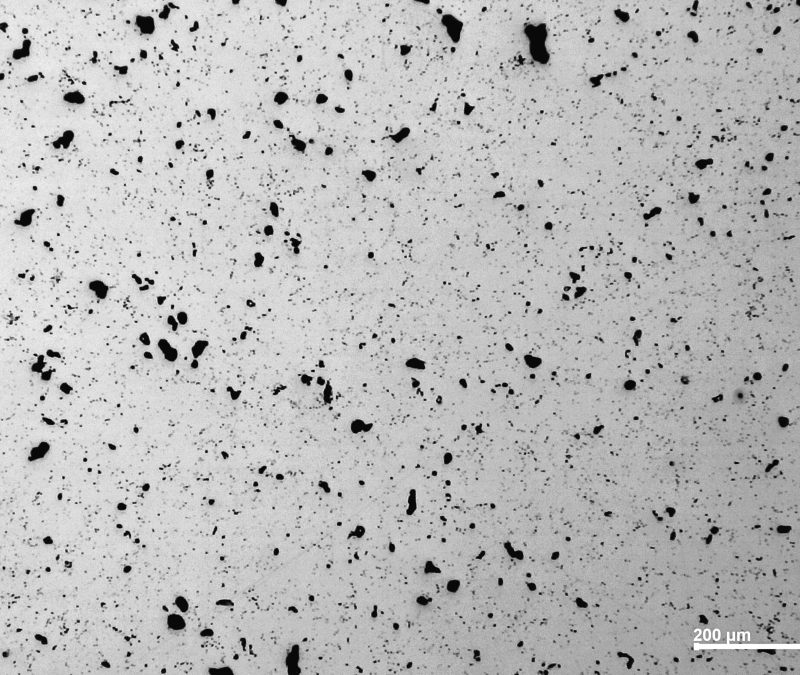
| Element | Percentage |
|---|---|
| Fe | Bal |
| C | < 0.05% |
| Si | < 0.65-0.9% |
| Cr | < 11.5-13% |
| Mn | < 0.15-0.45% |
| S | < 0.3% |
| CAST | SPEE3D PRINTED | WROUGHT | |
| (reference) (ASTM A743 CA15, to ASTM A487 Class D) | 410 Stainless Steel | (reference)(EN10088-3 1.4006 QT650) | |
| Yield Strength (MPa)1 XY,Z | 515 | 515 | 480 |
| Ultimate Tensile Strength (MPa)1 XY,Z | 690 | 645 | 720 |
| Elongation at break (min %)1 XY,Z | 17 | 10 | 20 |
| Vicker Hardness (HV)2 XY,Z | 185-255 | 201-218 | 190-230 |
| Corrosion rate (mmpy) | N/A | N/A | N/A |
ASTM Information:
- Specimens tested according to ASTM E8 Subsize Specimens.
- From ASTM E92-17 Standard Test Methods for Vickers Hardness and Knoop Hardness of Metallic Materials
Listed designations are for reference purposes only. Composition and mechanical properties may vary. End-use material performance is impacted (+/-) by certain factors including but not limited to part geometry and design, application and evaluation conditions.
Abbreviations:
XY = The XY direction is defined as the direction along a print layer.
Z = The Z direction is defined as the direction perpendicular to the print layer, normal to the XY plane.